













MEDITE SMARTPLY launches Beyond the Board, a new expert-led video series exploring the challenges shaping the future of construction
With hotter summers, high energy costs and the Future Homes Standard (FHS) on the horizon, the way homes are designed to balance energy efficiency, resilience and occupant wellbeing is coming under increasing scrutiny. In the first episode of its new Beyond the Board podcast series, MEDITE SMARTPLY brings together industry experts to examine one of the most fundamental elements of building design: the building envelope, and asks: “Is the secret to healthier, ultra-efficient homes hidden in the building envelope?”
The discussion comes as the construction industry prepares for the Future Homes Standard, which will come into force from 24th March 2027 for non-higher-risk-building dwellings. New homes will be required to produce at least 75% fewer carbon emissions than those built to 2013 standards, placing greater emphasis on how the building fabric performs alongside low-carbon heating and renewable energy technologies.
James Roberts MBE, architectural technologist, certified Passive House designer and Technical Adviser at Lowfield Timber Frames, and Simon Jones, founder and host of the Air Quality Matters podcast, agree that improving fabric performance is not simply a question of adding more insulation or making homes more airtight. Airtightness, ventilation, moisture management, material selection and build sequencing all interact to influence how a home performs and, crucially, the indoor environment experienced by its occupants.
As homes become more airtight in pursuit of better energy performance, getting that relationship right becomes increasingly important. A well-designed envelope can help reduce heat loss, manage moisture and support good indoor air quality. But focusing on individual elements in isolation can create unintended consequences elsewhere.
James explains: “The building envelope is not the entire answer, but I think it’s a good foundation where everything else is built upon.”
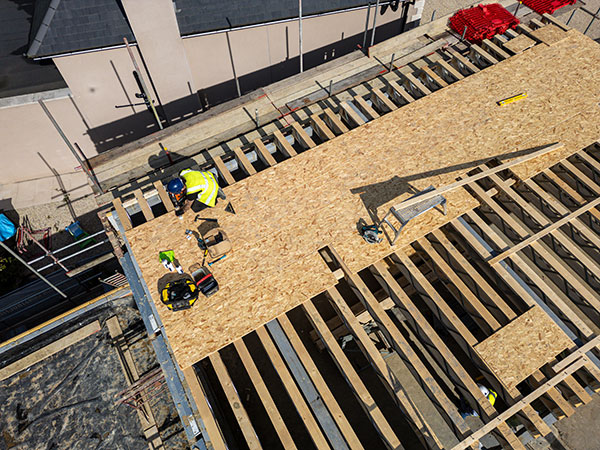
The challenge, therefore, is to consider the home as a complete system. Glazing orientation, insulation, airtightness, ventilation, moisture movement, materials and workmanship all need to work together if the finished building is to perform as intended.
This becomes particularly important when considering indoor air quality. A more airtight building requires an effective ventilation strategy, rather than relying on uncontrolled air leakage. As James explains in the episode: “If you have a good airtight building, you will need some mechanical ventilation to make sure that those rooms are comfortable and the air quality is good.”
The distinction between airtightness and ventilation is therefore critical. A draughty building is not necessarily a well-ventilated building, while an airtight home does not mean preventing fresh air from entering. Instead, the aim is to control how and where air moves through the building.
Moisture management is another fundamental part of the equation. Poor detailing that allows water or moisture into the building fabric can undermine other aspects of envelope performance, reinforcing the need to consider durability, airtightness, vapour control and insulation as interconnected parts of the same system.
The implications extend beyond energy performance. Simon highlights just how much of our lives are spent within the built environment: “If you live to 80 years of age, you’ll spend 70 years of your life indoors… You’ll spend 55 years of that in your own home. Twenty-five years of those 80 years will be in your bedroom, asleep.”
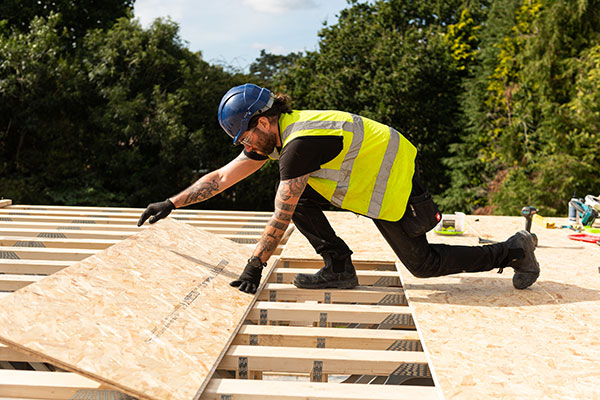
This makes the quality of the indoor environment, and the building envelope separating it from the outside world, an important consideration for long-term health and wellbeing.
The conversation also examines one of the construction industry's persistent challenges: the gap between designed performance and actual performance once a building is completed. With greater focus on real-world building performance, James argues that measurement will become increasingly important.
James says: “Actually measuring what’s being delivered is going to be huge, especially for the bigger housebuilders. They need to be able to deliver to that standard and be tested on it in years to come, so we know the building is performing as they said it would. The performance gap is real, and that is something the whole construction industry in the UK is going to have to come to terms with.”
Looking further ahead, data-driven analytics and sensors could transform how homes are monitored throughout their lifetimes, measuring factors such as energy performance, humidity and indoor environmental quality. Simon compares this evolution to the automotive industry, where modern cars use sensors to monitor performance, identify problems and provide manufacturers with continuous feedback to improve future products.
Simon explains: “The value of data from the built environment is very analogous to the automotive industry. The vast majority of vehicles are now collecting data from thousands of sensors. That data helps manufacturers refine and improve their products. That’s where buildings are heading.”

Signed, Sealed, Developed: Engineering the Building Envelope for Healthy Homes is the first episode of Beyond the Board, a new podcast-style video series powered by SMARTPLY.
Hosted by Roly Ward, Head of Business Development, and David Murray, Head of Technical Affairs & Ireland Sales, MEDITE SMARTPLY, the series will bring together technical specialists and professionals from across construction to explore the practical challenges shaping the future of the industry, from building performance and healthy homes to the skills gap.
Full episodes will be available via YouTube and Spotify.
Watch and listen to the first episode on YouTube: https://www.youtube.com/watch?v=adXZuLl4dBs
An audio-only version is also available on Spotify: https://open.spotify.com/episode/7vgJDSslVvwRDQDtRUEnfM?si=7ebSEONiSbeBfhOLuevufg
About MEDITE SMARTPLY
MEDITE SMARTPLY is part of the Coillte Group, an innovative, sustainably certified Irish forestry and forest products manufacturer. Based in Clonmel and Waterford, Ireland, MEDITE SMARTPLY produces a versatile range of Medium Density Fibreboard (MDF) and Oriented Strand Board (OSB) products for construction and interior applications across the UK and Europe. For further information, visit www.mdfosb.com.
Images © MEDITE SMARTPLY
- Log in to post comments