



















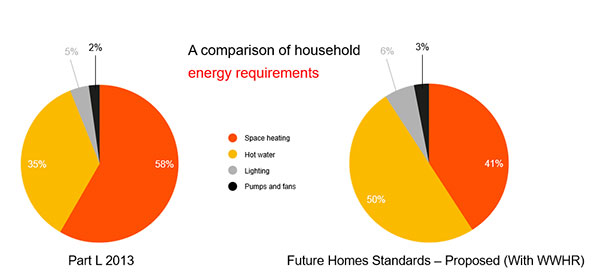
As the Future Homes Standard (FHS) moves into its final policy stage before implementation, the Waste Water Heat Recovery (WWHR) sector, led by Showersave and Recoup, has identified that the framework may limit opportunities for reducing domestic hot water (DHW) demand – despite hot water accounting for one of the largest energy demands in both new-build and existing homes undergoing decarbonisation and retrofit improvements.
The WWHR sector has gathered independent third-party feedback and modelled some national housebuilders’ house types with leading energy assessors. This has highlighted issues and warns that the evolving compliance approach will reduce design flexibility for housebuilders, housing associations, retrofit providers and residential design teams, with performance outcomes increasingly shaped by a narrower set of technologies, dictated by policy.
Under the interim Part L standards introduced in 2021, Waste Water Heat Recovery Systems (WWHRS) are widely adopted across new-build specifications. Since 2024, over 160,000 homes have been fitted with Showersave and Recoup WWHRS products, reflecting their role in helping developers and housing providers meet energy efficiency targets, while lowering energy costs for homeowners, tenants and residents.
WWHRS is included in the government’s notional dwelling for the Future Homes Standard (FHS). However, based on early review of SAP 10.3, the WWHR sector has concerns that demandreduction technologies such as WWHRS have been adversely affected in terms of their compliance impact and have, in practice, been deprioritised.
Worked examples within SAP 10.3 suggest that it is now possible to achieve compliance without incorporating such systems, which is inconsistent with the notional house specification set out for the FHS. This represents a clear misalignment between policy intent and modelling outcomes.

Importantly, SAP 10.3 was not part of the two year Future Homes Standard consultation and was never intended to be the primary longterm compliance tool for the FHS. As such, there remains an opportunity to review and amend SAP 10.3 so that it better reflects the substantial and wellevidenced energy savings that WWHRS can deliver.
The WWHR sector also warns that deprioritising domestic hot water demand reduction could have implications beyond new-build housing. As housing associations, local authorities and retrofit programmes work to decarbonise existing homes through electrification and heat pump deployment, reducing hot water demand is becoming increasingly important in managing running costs, peak electricity demand and real-world building performance.
In its current form, the SAP 10.3 compliance route risks undervaluing domestic hot water, which is one of the largest energy demands in modern dwellings. Historically, government policy has rightly placed strong emphasis on demandside reduction, an approach that has been widely supported across industry. That emphasis, however, appears to have been diluted under the FHS/SAP 10.3 framework, to the detriment of proven demandreduction measures such as WWHRS.
The opportunity to deliver typical bill reductions of £50-£250 to households, tenants and residents, while future-proofing homes for zero carbon has been deprioritised in favour of supply-side measures which will not solely benefit households. The WWHR sector warns that this imbalance could contribute to a gap between modelled and real-world energy performance, something government is keen to avoid.
Solar PV produces most of its output during summer months, when demand is lower, while heating and hot water demand peaks in winter. As a result, homes may meet compliance targets on an annual basis while still experiencing higher in-use energy costs than expected, and a reliance on high-cost grid energy during the winter heating season.
This is particularly relevant for housing associations, social landlords and retrofit providers seeking to minimise tenant energy costs during winter periods of peak demand.
Technologies such as WWHRS offer a cost-effective complementary demand-reduction approach. By recovering heat from shower wastewater to preheat incoming cold water, WWHRS deliver consistent efficiency benefits year-round, independent of seasonal variation.
Tony Gordon, Managing Director at Showersave, said: “One of the strengths of previous standards was that developers had flexibility in how they achieved compliance. If one measure wasn’t suitable for a particular site or design, it could often be balanced by others. While that flexibility still exists in principle, in practice compliance is becoming increasingly concentrated around heat pumps and solar PV systems, which risks stagnating the range of viable design approaches available to housebuilders, housing associations and retrofit teams, while limiting innovation.
“The concern is that this creates a more uniform approach to building performance, where domestic hot water – despite being the major energy demand in highly efficient homes – is not given sufficient weight within the compliance methodology. Relying heavily on annualised solar PV performance also risks a mismatch between when energy is generated and when it is needed, with implications for both running costs and system resilience.
“WWHRS are proven, widely deployed and deliver consistent savings regardless of season, offering a straightforward way to reduce energy demand within new homes. This is about ensuring developers, housing providers and retrofit professionals retain a broad and practical range of options to deliver homes that perform as intended, both in carbon terms and in real-world energy use.”
With tens of thousands of WWHRS installed in UK homes to date, the WWHR sector maintains that demand-reduction technologies remain an important part of the wider low-carbon toolkit available to all housebuilders, housing associations, local authorities and retrofit providers. Addressing DHW demand will not only improve household running costs, but it will also deliver significant benefits for the challenge of peak load on electricity infrastructure.
The WWHR sector is now calling for greater recognition of how energy is used within homes, alongside how it is generated, to ensure the FHS delivers both primary energy and cost reduction to Future Homes, as well as real-world performance outcomes. It argues that DHW and space heating can no longer be regarded as mutually exclusive considerations in homes of the future.
The sector argues that demand reduction technologies such as WWHRS can play an important supporting role in both future homes and the decarbonisation of existing housing stock, particularly where reducing operational energy demand and protecting occupants from rising electricity costs are key priorities.
For more information, visit www.showersave.com | www.recoup.co.uk
Images © Showersave
- Log in to post comments